
Kenya flying safaris
The Mara is five to six hours by road from Nairobi. It is forty-five minutes from Wilson. Flying does not buy you luxury — it buys you back the hours you would otherwise spend on the C12.
- Block
- 0h45
- Aircraft
- C208
- Bag
- 15 kg
- By road
- 5–6h
Typically direct or one intermediate stop
covered
mapped
bag limit
Caravan
Your bag must be soft‑sided and weigh no more than 15 kg in total, hand luggage included. Wheeled hard cases are refused at the aircraft. What that actually means →
01 · The argument
Flying is not a luxury. It is arithmetic.
Every hour on a Kenyan trunk road is an hour not spent in a park at the time of day the animals are moving. On a multi‑park route the numbers stop being close.
The honest counter‑argument: on a single‑park trip with a long stay, road transfer is often the better call. You see the Rift escarpment, the Ewaso Ng’iro, the shift from wheat country into Loita grassland — and you save the flight cost. The case for flying gets stronger with every park you add and every day you subtract.
| Leg | By road | By air | Returned to you |
|---|---|---|---|
| Nairobi → Masai Mara | 5–6h | 0h45 | ~4.5h |
| Nairobi → Amboseli | 4–5h | 0h45 | ~3.5h |
| Nairobi → Samburu | 5–6h | 1h15 | ~4h |
| Masai Mara → Amboseli | 10–12h | 1h15 | ~9h |
| Masai Mara → Diani | 14–16h | 1h45 | ~13h |
| Masai Mara → Laikipia | 8–10h | 1h15 | ~7.5h |
Road times assume dry conditions and no incident on the Narok or Mombasa roads. Air times are block times for the leg only and exclude the check‑in window at Wilson and any intermediate stop. Neither column is a schedule.

02 · The constraint
Fifteen kilos, and it has to squash.
This is the single rule that catches people out, and the one nobody tells you until you are already packed. It is not an airline being difficult. A Caravan’s pannier is a fixed shape, and a rigid case simply does not go in.
The limit is 15 kg per passenger in total — checked and hand baggage together, camera bag included. The bag itself must be soft‑sided and collapsible, with no external frame, no rigid spine and no wheels housing. A common working maximum is roughly 61 × 30 × 30 cm when packed.
Some operators will carry more on some routes, sometimes by purchasing part of a seat — but that is arranged in advance, never at the strip. Confirm your own allowance with us at booking, because it varies by carrier, aircraft and leg.
What to do with the rest of it
Leave it in Nairobi. Left‑luggage storage at Wilson and at most Nairobi hotels is straightforward, and if your trip ends with a beach leg or an international flight you will collect it on the way through. Camps launder daily and cheaply, which is what makes 15 kg workable across a ten‑day trip.
Total, all bags, per passenger
Goes in the pannier
- Canvas or nylon duffel, no frame
- Collapsible holdall with soft handles
- Padded camera bag — counts in the 15 kg
- Daypack worn on board
Turned away at the strip
- Wheeled hard‑shell suitcase
- Aluminium camera flight case
- Framed rucksack with rigid stays
- Golf bag, rifle case, rigid tripod tube
Passengers above roughly 100 kg are normally asked to declare their weight in advance so the load sheet balances; on some legs an additional seat is purchased. This is a weight‑and‑balance requirement, and it is handled quietly at booking, not in front of anyone.
03 · The legs
Twenty‑three flight legs, one departure hub.
Almost every safari flight in Kenya leaves from Wilson Airport, not JKIA. The legs below are the ones that carry the traffic. Each has its own page with routing, seasonality and connection risk.
- Block
- 0h45
- Aircraft
- C208
- Road
- 4–5h
Usually direct · Kilimanjaro off the left wing
- Block
- 1h15
- Aircraft
- C208
- Road
- 5–6h
Often via Nanyuki or Lewa
- Block
- 0h40
- Aircraft
- C208
- Road
- 3–4h
Gateway to Lewa, Loisaba, Ol Pejeta
- Block
- 1h15
- Aircraft
- C208
- Road
- 10–12h
The leg that makes two‑park trips possible
- Block
- 1h45
- Aircraft
- C208
- Road
- 14–16h
Normally one stop · bush‑to‑beach in a morning
- Block
- 1h40
- Aircraft
- C208
- Road
- Not advised
Often via Malindi · dhow transfer on arrival
Block times are indicative for planning and vary with routing, load and wind. We do not publish schedules or seat availability — those are confirmed with the operator at the time of booking.
04 · The network
Twenty‑eight airstrips, and the one you land on changes your day.
In the Mara alone there are eleven. Choosing a camp without checking which strip serves it is how people end up with a ninety‑minute game drive transfer they did not budget for — or, better, a twelve‑minute one.
Masai Mara
Laikipia, Samburu & the north
Tsavo, Chyulus, Meru & the Rift
Coast & islands

Sample entry
Ol Kiombo
| Region | Central Masai Mara National Reserve |
|---|---|
| Serves | Talek and Ntiakitiak camps; Naboisho and Olare Motorogi conservancy properties |
| Surface | Graded murram |
| Typical transfer | 10–45 min by game drive vehicle, camp dependent |
| Terminal | Open shelter and windsock. No cafe, no shop, no fuel for passengers. |
| Wet season | Usable, but expect surface delays after sustained rain |
Every one of the twenty‑eight strip pages answers this same set of questions in this same order.
05 · The day
Why your flight stops three times.
Scheduled safari flights are milk runs. The aircraft works a circuit, dropping and collecting at each strip. You stay on board, the door opens, two people get off, someone hands up a bag, and you go again. Nobody explains this in advance and it alarms first‑time passengers.
- WilsonDep
- Keekorok+0h45
- Ol Kiombo+1h05
- Musiara+1h20
- Serena+1h35
An illustrative circuit only. The practical consequence: if your camp is served by the third stop, your journey is longer than the headline block time — and if it is served by the first, it is shorter. We tell you which before you book, because it changes which camp is the right one.
-
Check in at Wilson, not JKIA
Different airport, roughly 18 km apart, 30–60 minutes by road depending on Mombasa Road traffic. Arriving at the wrong one is the most expensive mistake on this list.
-
Bags weighed, and so are you
The whole load is weighed because a light aircraft has to balance. Expect it, and expect the scale to be honest about your 15 kg.
-
Walk out to the aircraft
No jetway, no boarding groups. The pilot briefs you at the steps and often assigns seats by weight distribution rather than preference.
-
Fly low, and look out
Cruise is low enough to see game on the way in. The Rift escarpment on the Mara run and Kilimanjaro on the Amboseli run are both genuinely worth the window seat.
-
Land, and be met
Your camp’s vehicle waits at the strip. There is no arrivals hall — usually a shelter, a windsock and a driver holding a board with your name on it.
-
Transfer becomes the first game drive
The run from strip to camp is inside the reserve or conservancy. Have your camera out of the bag before you land.
06 · Where the legs go
Fly‑in destinations.
Each of these has a page covering only the flying angle — which strips serve it, which legs connect it, and whether flying there is actually the right call.
 WIL → 0h45
Masai Mara
Eleven strips, the densest air network in the country. Between July and October the flying itself becomes the reason — you cross the herds on the way in.
 WIL → 0h45
Amboseli
One strip, one mountain, and the best approach view in Kenyan aviation. Sit on the left out of Wilson.
 WIL → 1h15
Samburu
Northern species you will not see in the Mara. The road up is long enough that flying changes the trip from four days to two.
 WIL → 0h40
Laikipia
Private conservancies with their own strips. Walking, riding and night drives that the national parks do not permit.
 WIL → 1h00
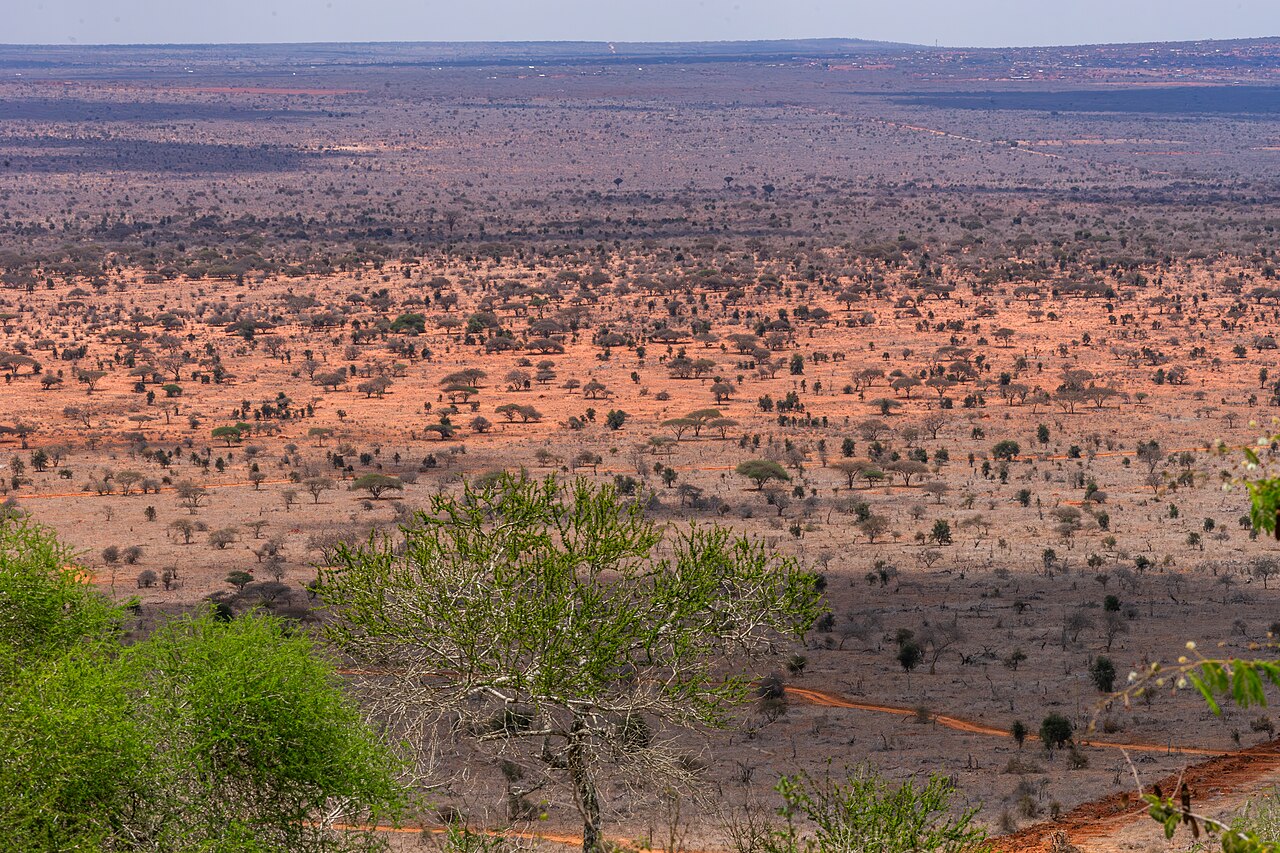
Tsavo
Vast enough that the drive between its own lodges is a day. This is the park where flying stops being optional.
 WIL → 0h50
Meru & Lewa
Quiet, well‑run and almost always reached by air. Meru in particular sees a fraction of the Mara’s visitors.
 MARA → 1h45
Diani
The standard bush‑to‑beach finish. Leave the Mara after a morning drive, be in the Indian Ocean by mid‑afternoon.
 WIL → 1h40
Lamu
Land on Manda, cross by dhow. There is no realistic road alternative, which makes this the purest fly‑in destination in Kenya.
07 · What you will be sitting in
Four aircraft do almost all of it.
You will almost certainly board the first one. Knowing the layout in advance is the difference between a good window seat and an hour looking at a wing root.
Cessna 208 Caravan
Single turboprop · high wing
12–13 passengers. High wing means an unobstructed view downwards — the reason it dominates the safari network. Ask for a seat forward of the wing strut.
Caravan detailDHC‑6 Twin Otter
Twin turboprop · high wing
Up to 19 passengers and famously untroubled by short, rough strips. Louder than the Caravan. Common on higher‑density Mara legs.
Twin Otter detailCessna 206
Single piston · high wing
5 passengers. Reaches strips the scheduled network does not serve. The usual answer for a small group going somewhere off the circuit.
C206 detailAirbus H125
Single turbine helicopter
5 passengers. Lands where there is no strip at all — crater floors, ridgelines, fly‑camps. Costed by the hour, not the seat.
Helicopter detailSeat counts are typical configurations and vary by operator. Aircraft assignment is the operator’s decision and can change on the day for load or maintenance reasons.
08 · Trips built around the legs
Itineraries that only work because you fly.
These are not road itineraries with flights bolted on. Each is shaped by which legs exist, which strips connect, and where the milk run makes an early start unavoidable.
Mara & Amboseli
Six days · two parks · two flight legs
- Day 1WILSON → MARA · 0h45
- 2–3Mara conservancy, full days
- Day 4MARA → AMBOSELI · 1h15
- Day 5Amboseli, Kilimanjaro at dawn
- Day 6AMBOSELI → WILSON · 0h45
North & the Mara
Eight days · three regions · three legs
- Day 1WILSON → SAMBURU · 1h15
- 2–3Samburu, northern specials
- Day 4SAMBURU → LEWA · 0h30
- Day 5Laikipia, walking and riding
- Day 6LEWA → MARA · 1h15
- 7–8Mara, then home
Bush & beach
Seven days · Mara to the south coast
- Day 1WILSON → MARA · 0h45
- 2–3Mara, migration season optional
- Day 4MARA → DIANI · 1h45
- 5–6Diani, reef and rest
- Day 7DIANI → NAIROBI · 1h10
09 · What moves the number
We do not publish prices, and here is why.
Safari flight costs move with season, party size, camp category and which legs you need. A number on a web page is either out of date or hedged into uselessness. What we can give you is the mechanism, so you can see where your quote comes from.
01 · Number of legs
Each leg is priced separately. A three‑park trip carries four flights, not three — the return to Nairobi counts.
02 · Scheduled or charter
Scheduled is per seat. Charter is per aircraft hour. Somewhere around four to six travelling together, charter starts to compete.
03 · Season
July to October and the festive period carry peak seat pricing and sell out early. April and May are the other end of both.
04 · Which strip
A strip on the main circuit is cheaper to reach than one requiring a dedicated positioning leg. Camp choice is a flight‑cost decision.
05 · Park and conservancy fees
Separate from flights and from camp rates, charged per person per night or per day. Conservancy fees are typically higher than reserve fees.
06 · Excess baggage
Where an operator permits it at all, it is bought as part of a seat and arranged in advance. Budget for it or pack to the limit.
Who is flying you
| Regulator | Kenya Civil Aviation Authority (KCAA) licenses every operator and pilot on this network |
|---|---|
| Operator | Kambu Campers Ltd — licensed Kenyan tour operator and camp owner in the Masai Mara |
| Medical cover | AMREF Flying Doctors evacuation membership is available for the trip duration and we recommend it on every fly‑in itinerary |
| Entry | Most visitors need an approved eTA before travel. Apply through the official Kenyan government portal only. |

10 · Asked constantly
The questions we answer every week.
If yours is not here, message us. We would rather answer it before you book than after you have packed.

Can I really only take 15 kg?
On the standard scheduled network, yes — and that figure includes hand luggage and camera bags. Some operators and some legs allow more, arranged in advance and usually by buying part of an additional seat. It is never negotiated at the airstrip. Confirm your specific allowance with us when you book.
Do I fly from JKIA or Wilson?
Wilson, almost always. It is a separate airport roughly 18 km from JKIA and the transfer takes 30–60 minutes depending on traffic. If you land internationally at JKIA and connect the same day, allow a generous window — we plan this leg deliberately rather than optimistically.
Why does my flight stop at other airstrips?
Scheduled safari flights work a circuit, dropping and collecting passengers at several strips on the same run. You normally stay on board. Your camp’s strip determines whether you are the first stop or the last, which is why we check that before recommending a camp.
Is flying in a small aircraft safe?
Every operator and pilot on this network is licensed by the Kenya Civil Aviation Authority and works to commercial maintenance and duty standards. That said, light aircraft operations are more weather‑ and surface‑sensitive than jet operations, which is why delays happen and why schedules are held loosely. We also recommend AMREF Flying Doctors evacuation cover on every fly‑in itinerary.
What happens if my flight is delayed or cancelled?
Your camp is informed and the vehicle waits. Delays are usually weather or load related and typically resolve within the same day. The real risk sits on the last day of a trip, which is why we do not schedule a safari flight and an international departure tightly on the same day.
Will I be weighed?
Your baggage certainly. Passenger weights are required for the load sheet, and passengers above roughly 100 kg are normally asked to declare in advance so seating and balance can be arranged — occasionally by purchasing an extra seat. It is a weight‑and‑balance requirement, handled at booking rather than publicly.
Can children fly on safari aircraft?
Yes. Infants and children are carried, though seat and weight rules differ by operator and some charters set minimum ages. Ear pressure on the descent is the usual practical issue; the flights are short, and cabin altitude changes are gentle.
Should I charter privately instead?
It depends almost entirely on group size and where you are going. Charter is priced per aircraft hour rather than per seat, so somewhere around four to six travelling together it starts to compete — and it becomes the only option for strips the scheduled network does not serve. It also removes the milk‑run stops and lets you set your own departure time.
Is a flying safari worth it for one park?
Often not. For a single park with a stay of four nights or more, a road transfer costs less and shows you a great deal of the country on the way. The case for flying strengthens sharply from the second park onward and is overwhelming on any Mara‑to‑coast or Mara‑to‑north combination.
Plan it with an operator, not an aggregator
Tell us the days you have. We will tell you what flies.
We own and run a camp in the Mara and we meet these flights ourselves. Send us your dates, party size and the parks you want, and you will get a routing that accounts for the strips, the stops and the connection windows — not a template.
Licensed Kenyan tour operator · Nairobi & Masai Mara